On propane grills, a low flame that won't climb past about 300 degrees is usually the regulator's excess flow safety, and a 2-minute reset fixes it. If that doesn't help, look at clogged burner ports and orifices. On natural gas built-ins, an undersized or overly long gas line is a common cause.
Key points
- Most gas grills should reach about 500 degrees or more on high, lid closed, in 10 to 15 minutes.
- The propane regulator's safety trips when the tank is opened fast or a knob is left on. Resetting it is free.
- Swap in a different propane tank to rule out a bad tank valve before blaming the grill.
- Clogged ports, webbed burner tubes and dirty orifices starve the burners.
- Natural gas grills need a line sized for the total BTUs and the length of the run. Many built-ins call for 3/4 inch pipe.
How hot should a gas grill get?
With all burners on high and the lid closed, most gas grills reach about 500 degrees or more in 10 to 15 minutes. Heavy built-ins with thick grates can take a bit longer. If yours stalls around 250 to 350 degrees, or the flames look like small blue nubs barely coming off the ports, something is starving the burners of gas.
One quick note: the lid thermometer can be off by a lot. If food sears fine and only the dial reads low, test the thermometer in boiling water before you chase a gas problem.
Need the part? Pro Grill can find it
Send us your brand, model and the part you need. We source OEM parts, including ones that aren't listed in our online store.
Ask Pro Grill for a partWant a pro to handle it?
Most companies in our network are dealers or have dealer accounts, so they can usually bring the right part and install it in one visit.
Likely causes, in the order we see them
- Propane regulator safety tripped (the most common cause by far).
- Low, cold or faulty propane tank.
- Clogged burner ports from grease, rust or carbon.
- Spider webs in the burner tubes or dirty orifices.
- Natural gas line too small or too long for the grill's BTU demand.
- Wrong orifices or regulator, usually after a propane to natural gas conversion.
- Worn or sticking gas valves.
- Wind, a warped lid or missing heat plates letting heat escape.
The propane regulator safety, and how to reset it
The regulator on a standard propane hose has a built-in excess flow safety, sometimes called the bypass. If it senses gas flowing faster than normal, the way it would with a cut hose, it cuts flow down to a trickle. The grill still lights, but the flame stays tiny.
It trips most often when someone opens the tank valve quickly, opens it with a burner knob already on, or shuts the tank off before the knobs at the end of a cook. To reset:
- Turn every burner knob off, including side burners.
- Close the tank valve.
- Disconnect the regulator from the tank and wait about 5 minutes. Some techs also open a burner knob for a minute while it's disconnected to bleed the hose, then turn it back off.
- Reconnect the regulator, hand tight all the way.
- Open the tank valve slowly, a quarter turn at first, then all the way.
- Wait about 30 seconds, then light one burner and bring the others on after.
To keep it from coming back, always open the tank slowly with knobs off, and at shutdown turn the knobs off before the tank.
What about the OPD tank valve?
Every portable tank sold now has an overfill prevention device, the valve with the triangle-shaped handwheel. It stops the tank from being overfilled, and it doesn't need resetting. Once in a while, though, a tank valve sticks or restricts flow after a refill. If a regulator reset doesn't help, borrow or swap a different tank before you buy a regulator. If the new tank fixes it, return the old one to the exchange.
Cold weather
Propane turns from liquid to gas more slowly in the cold. A low tank on a cold Utah morning may not keep up with a big grill on high. A fuller tank and a little patience help.
Clogged burners and orifices
Grease, carbon and rust close off the small ports along the burner. Spiders and mud daubers build in the burner tubes, and the Weber and other manufacturers' manuals list "not reaching temperature" as a sign of insects in the venturi. With the gas off and the grill cool:
- Pull the grates and heat plates and lift out the burners.
- Brush the burner tops with a stiff brush and clear each port with a straightened paper clip or a small drill bit turned by hand. Don't enlarge the ports.
- Run a venturi brush or flexible bottle brush through each burner tube.
- Look at the orifice, the small brass fitting at the end of each valve that the burner tube slides over. Blow out any debris. Never drill an orifice.
- Reinstall each burner so its inlet sits over the orifice, then light and check the flame.
If burners are rusted through or the ports have burned out into wide slots, replace them. A deep cleaning often fixes this whole category at once. See how to deep clean a gas grill, or book a grill cleaning service.
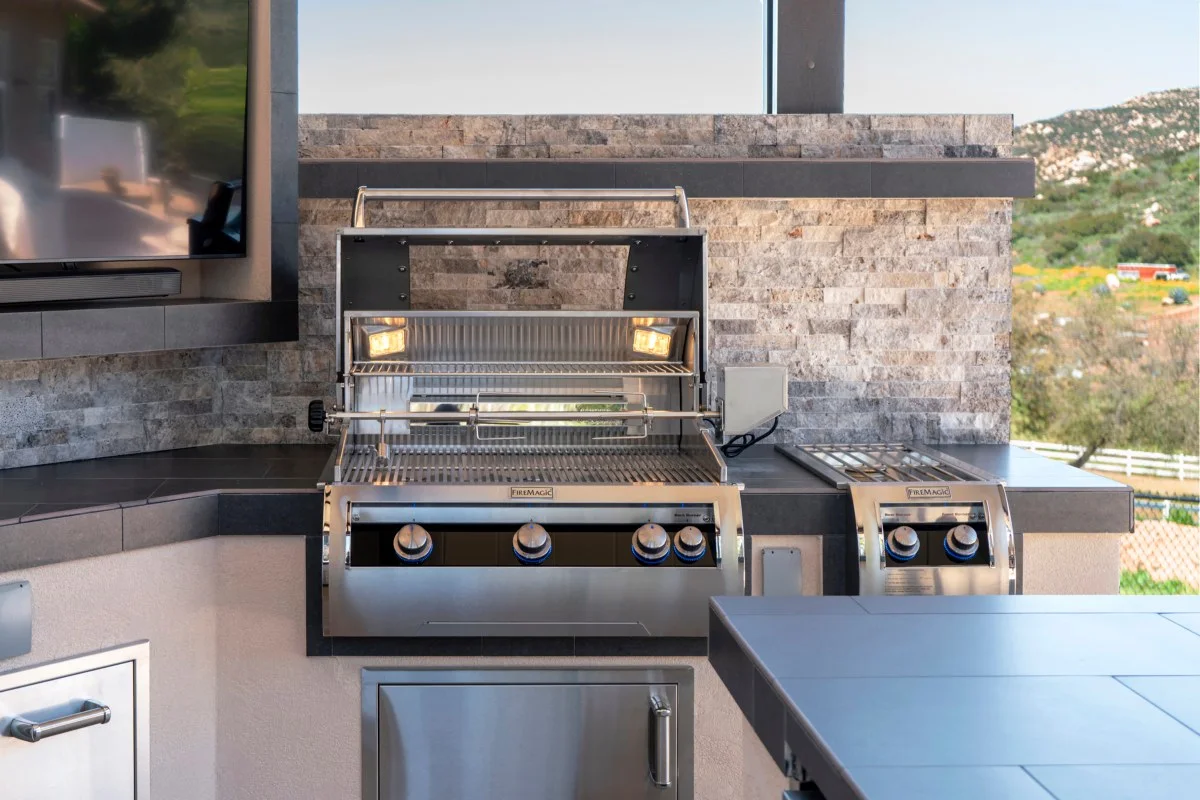
Natural gas line sizing
On natural gas built-ins, we often find a perfectly good grill on a line that can't feed it. Gas line size depends on two things: the total BTUs of everything on that line and the length of pipe from the meter. Under the common sizing tables, a 1/2 inch steel pipe 50 feet long carries only about 70,000 BTU per hour at normal household pressure, while 3/4 inch pipe at the same length carries roughly twice that. A large built-in, a side burner and a fire pit on one line can easily need more than a 1/2 inch run can deliver.
Signs of an undersized line:
- The grill is fine with one or two burners on but falls flat when all of them are on high.
- Flames drop when the side burner, fire pit or another appliance turns on.
- A thin flexible hose or quick-disconnect is the last few feet of the run.
Several premium built-in manufacturers call for no less than 3/4 inch pipe to the grill in their installation manuals. A tech or plumber can confirm with a manometer, measuring gas pressure at the grill with every burner on high and comparing it to the rating plate. Fixing it means a larger line or a shorter run, which is a job for a licensed plumber. If you're planning an island, sort this out before the grill goes in. Our grill installation cost guide covers what installers check.
Wrong orifices after a conversion
Propane orifices are much smaller than natural gas orifices. A grill switched to natural gas without changing every orifice (and the regulator, on most brands) burns weak and never gets hot. Our propane to natural gas conversion guide covers what a proper conversion includes.
What a pro does and when to call
Call a tech if a reset and a tank swap don't help, if a burner won't stay lit, if you smell gas, or if you suspect the line size or a valve. Techs measure pressure at the manifold, check the regulator output, clean or replace orifices, replace sticking valves and confirm the conversion kit matches your gas. Most service companies in our network are dealers or have dealer accounts, so they can usually get the right regulator, valve or burner and install it on the same visit. Find a grill pro near you or schedule grill burner and valve repair.
Parts that usually fix it
- Regulator and hose when a reset won't hold. See the regulator and hose cost guide.
- Burners when ports are rusted or burned out. Prices in the burner cost guide.
- Valves when one burner stays low no matter what. OEM only. See the valve cost guide.
Get the model and serial number before ordering. You can shop Alfresco parts at the Pro Grill store, where fitment depends on the serial number, or have Pro Grill track down a part that isn't listed.
Frequently asked questions
Why is my propane grill flame so low?
Most often the regulator's excess flow safety has tripped. Turn off the knobs and tank, disconnect the regulator for about 5 minutes, reconnect, open the tank slowly and light one burner. If that doesn't help, try a different tank, then check for clogged burners.
How long should a gas grill take to heat up?
With all burners on high and the lid closed, most gas grills reach about 500 degrees or more in 10 to 15 minutes. Much longer than that, or stalling around 300, points to a gas flow problem.
Can a natural gas line be too small for a grill?
Yes. The line has to carry the total BTUs of every appliance on it over the full length of the run. Long 1/2 inch runs are a common cause of weak flames on large built-ins, and many manufacturers call for 3/4 inch pipe.
Do I need a new regulator if my grill won't get hot?
Not usually. Try the reset and a different tank first. Replace the regulator if it keeps tripping with a known good tank or the grill still runs low after a reset.
Why does my grill get hot on one side only?
One cold burner usually has a blocked tube, a dirty orifice or a sticking valve. Clean the burner and orifice first. If it still runs low, have a tech check the valve.