If the burner lights but goes out when you release the knob, it has a safety valve: keep holding the knob in until it stays lit, and if it still drops out, the thermocouple is likely weak or dirty. If it will not light at all, check the igniter and the gas supply. If it pops, flames on the surface, or glows in patches, look for cracked ceramic tiles, which usually means a new burner.
Key points
- Many infrared burners have a safety valve. Hold the knob in until the burner stays lit.
- A burner that drops out after you let go usually has a weak or dirty thermocouple.
- Cracked ceramic tiles cause popping and uneven glow. Most makers say replace the whole burner.
- Never spray water on a hot ceramic burner. Thermal shock cracks the tiles.
- Cool spots at the ends of a rotisserie burner are normal.
How infrared grill burners work
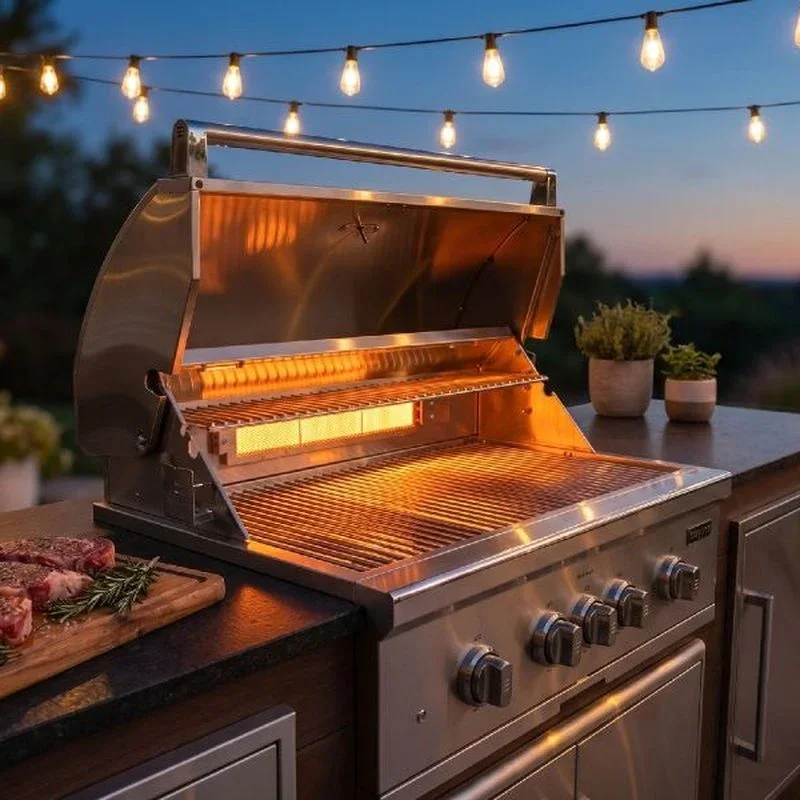
Infrared burners push a gas and air mix through a ceramic tile with thousands of tiny holes, or through a fine stainless mesh. The gas burns right at the surface, the tile glows orange red, and it throws intense radiant heat. You will find them as sear burners in the main cooking area and as rear rotisserie burners on many built-ins.
Because they work differently from a tube burner, they fail differently. A healthy infrared burner lights within a few seconds, glows evenly across the face after a few minutes, and runs quietly. Some cooler spots near the ends are normal.
Need the part? Pro Grill can find it
Send us your brand, model and the part you need. We source OEM parts, including ones that aren't listed in our online store.
Ask Pro Grill for a partWant a pro to handle it?
Most companies in our network are dealers or have dealer accounts, so they can usually bring the right part and install it in one visit.
Common causes, in the order techs see them
1. Not holding the safety valve long enough
On many rotisserie and some sear burners, the valve has a safety feature. You push the knob in, light the burner, and keep holding while a thermocouple heats up. Let go too soon and the gas shuts off. DCS, for example, tells owners to keep the button pressed until the rotisserie burner stays lit. Plan on holding it for at least 30 seconds and longer on a cold day.
2. Weak, dirty or misplaced thermocouple
If you hold the knob for a full minute or more and the burner still goes out the moment you let go, the thermocouple is the usual cause. It may be coated in grease, bent out of the flame, loose where it threads into the valve, or simply worn out.
3. Igniter problems
The igniter electrode sits close to the burner face. It gets coated in grease, cracks at the ceramic insulator, or gets bumped out of position. A dead battery in a push-button module or a loose wire also stops the spark. See our guide on igniters that won't spark for full checks.
4. Cracked ceramic tiles
Tiles crack from impact, from water hitting a hot burner, or from age. A cracked tile lets flame burn on top of the surface instead of inside it. Signs include popping, small blue or yellow flames dancing on the face, black patches that will not glow, or a burner that goes out on its own. Solaire's maker says replacing just the ceramic plate is rarely successful and recommends replacing the full burner, and that matches what we see in the field.
5. Clogged tile ports
Grease, marinade and food dropping onto a ceramic burner can block its tiny ports. Washing the burner with water or degreaser makes it worse. A clogged burner glows in patches or will not light well.
6. Spider webs in the venturi or orifice
Like any burner, infrared burners need clear airflow at the venturi. Webs and nests cause weak flame, popping at the valve end, or gas smells.
7. Low gas supply
Infrared burners draw a lot of gas. A nearly empty propane tank, a tripped excess flow device in the tank fitting, or an undersized natural gas line can leave them struggling while smaller burners seem fine.
Step-by-step checks you can do
- Let the grill cool fully. Turn the gas off before you touch anything near the burner.
- Look at the burner face with a flashlight. Note any cracks, chips, missing tile pieces or heavy black buildup.
- Find the igniter electrode and thermocouple tip next to the burner. Wipe them gently with a dry cloth or fine abrasive pad. Make sure neither is bent away from the burner face.
- Turn the gas back on. Open the hood. Push and turn the knob to light, then keep holding it in for a full minute before releasing.
- If it will not spark, check the igniter battery and wires. If it sparks but will not light, check the gas supply and look for webs at the venturi.
- If it lights, let it run on high for 10 to 15 minutes. This burns off grease in the ports. Watch for patches that stay dark or flames on the surface.
- Clean only with a soft brush or low-pressure air when cool. Never use water, a wire brush or a pick on ceramic tiles.
If you see cracks, the burner should be replaced. Using a cracked infrared burner can lead to flashback behind the tile.
What a pro does and when to call
Call a pro if the burner drops out after a long hold, if you see cracked tiles, or if you smell gas near the valve. A tech will test the thermocouple, check that it is seated in the valve, check gas pressure, and replace the thermocouple, safety valve or burner as needed. Valve and thermocouple work is part of the gas safety system, so we do not recommend doing it yourself. Most companies in our network are dealers or have dealer accounts and can usually get the correct OEM burner and install it in one visit. Find one through our list of grill repair specialists or search by ZIP code. A deep grill cleaning at the same time clears the grease that clogs ports in the first place. Our grill repair cost guide covers typical service pricing.
Parts that usually fix it
- Replacement infrared and rotisserie burners: see infrared burner costs.
- Safety valves and standard valves: see grill valve prices.
- Igniters, electrodes and thermocouples: see ignition part prices.
- Rotisserie kits and motors: see rotisserie parts costs.
Infrared burners and thermocouples are model specific. Lynx, Fire Magic, DCS and Twin Eagles each use their own designs, and some brands changed burners between production runs. Get the model and serial number before ordering, and buy OEM for burners, valves and thermocouples. See the DCS parts guide or Twin Eagles grills for brand notes. You can shop Twin Eagles parts at the Pro Grill store, and if your burner is not listed, ask Pro Grill to source it.
Frequently asked questions
Why does my infrared burner go out when I let go of the knob?
It has a safety valve that needs the thermocouple to heat up first. Hold the knob in longer, a full minute if needed. If it still goes out, the thermocouple is probably weak, dirty or out of position.
Can I replace just the cracked ceramic tile?
On most grills, no. Manufacturers generally sell the infrared burner as one assembly, and tile-only repairs rarely hold up. Plan on replacing the whole burner.
Why does my infrared burner pop?
Popping usually means flashback from a cracked tile, clogged ports or a blocked venturi. Turn it off and inspect it. A burner that keeps popping should be replaced.
How do I clean an infrared burner?
Run it on high for 10 to 15 minutes after cooking to burn off drippings, then brush lightly with a soft brush once cool. Never use water, degreaser or a wire brush on ceramic tiles.
Is it normal for the ends of a rotisserie burner to stay dark?
Some cooler spots at each end are normal on many rotisserie burners. Dark patches in the middle of the burner are not.